
Why Was My Minnesota Workers' Compensation Claim Denied?
Introduction
Opening the mail to find a flat-out denial of a workers' compensation claim can be a massive shock. When managing the physical pain of a work injury and the financial stress of missing shifts, receiving notice that a claim has been rejected feels incredibly unfair. In Minnesota, the clock moves fast after an injury. While the law requires insurance companies to act quickly, it also gives them several avenues to dispute a claim right out of the gate.
Receiving a form called a Notice of Insurer’s Primary Liability Determination (NOPLD) stating that a claim has been denied often leaves an injured worker wondering what went wrong. Insurers rely on a specific set of statutory defenses to reject coverage. Understanding the exact reason behind the denial is the first step toward fighting back and securing deserved benefits. Below are the most common reasons Minnesota workers' comp claims are denied and what they mean for an injured employee's case.
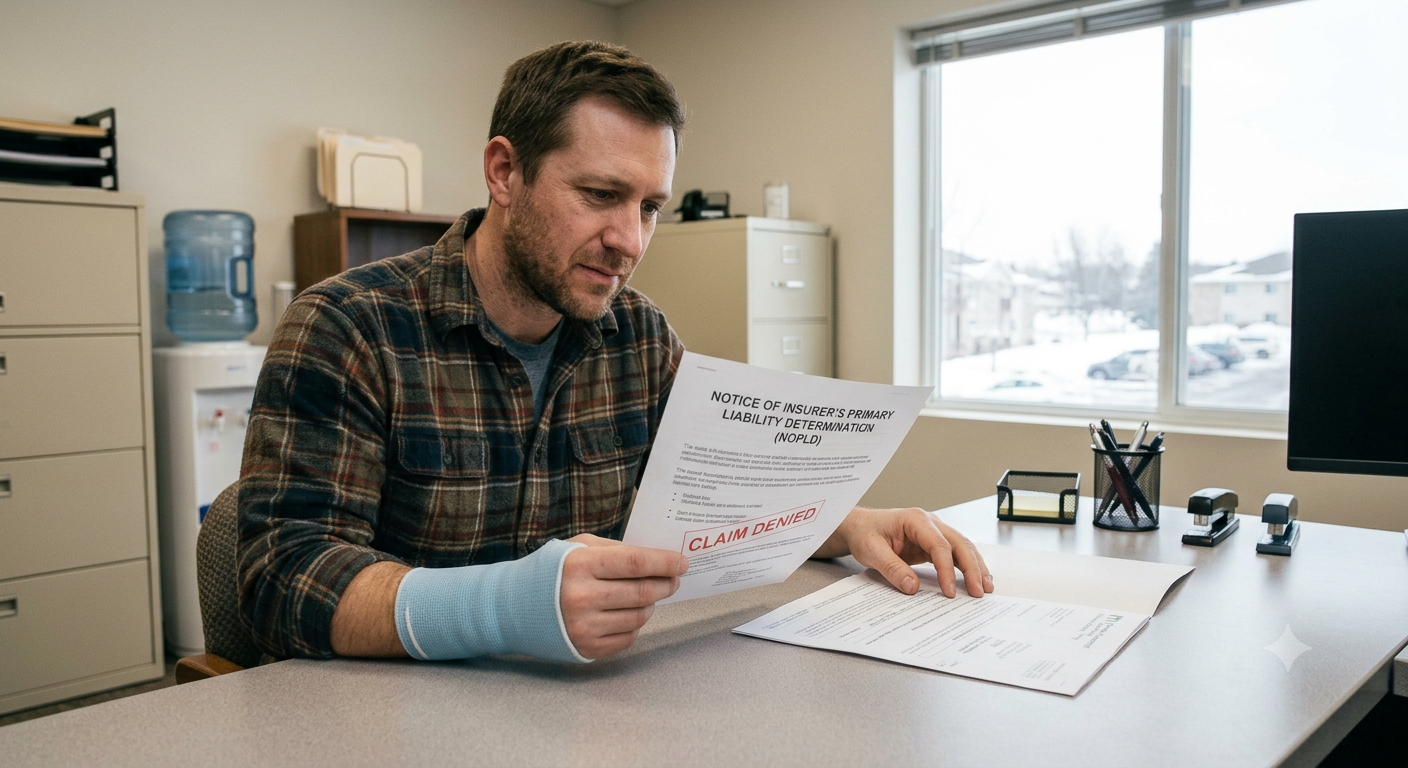
Notice of Insurer’s Primary Liability Determination
If the injured worker is off work because of the injury, the Insurer is required by statute to either deny liability, or admit liability and begin paying temporary total disability benefits within 14 days. The Insurer should send the injured worker a form called a Notice of Insurer’s Primary Liability Determination, which will say whether the claim is accepted or denied. If the claim is denied, the form should say the reason.
The Employer is responsible for any injury that arises out of and in the course of employment. The Employer may deny liability for any injury that it believes did not arise out of and in the course of employment. Some of the more common reasons that Insurers deny liability are discussed below. The employee has the right to dispute the insurer’s denial of a claim for workers’ compensation benefits.
No Injury
The most intuitive (although not the most common) reason that insurers deny workers’ compensation claims is based on an argument that no injury occurred. When this occurs, the insurer will commonly point to inconsistencies between the injury reported by the employee, and medical records, statements from coworkers, or other sources of information.
Medical Causation
Causation is the most common reason for a workers’ compensation insurer to deny liability. The Insurer does not dispute that an accident or incident occurred as reported. The Insurer does not dispute that the employee has a medical condition and needs medical treatment. However, the insurer is arguing that the accident did not cause the medical condition.
Just because a person has a pre-existing medical condition does not mean that he or she was not injured. If a work-related injury is a substantial contributing factor to the development, aggravation or acceleration of a pre-existing medical condition, then that medical condition is covered by the Workers’ Compensation Act. However, insurers very often attempt to incorrectly deny claims based solely on the existence of a pre-existing condition.
Not an Employee
It is most often very clear and obvious whether a person is an employee of an organization or another person. Occasionally, an insurer may argue that an injured worker was a volunteer, an independent contractor, or was otherwise not an employee.
In general, an employment relationship exists when a person is performing a service for another with the expectation of payment. However, there are several types of employment relationships that are excluded from workers’ compensation coverage. For example, casual employees and independent contractors are excluded from coverage.
An independent contractor is generally someone who is running a business that serves multiple customers with special expertise or skill that the customers don’t have for a profit. An employee is generally someone who is being paid for his or her time to perform a task.
Not in the Course of Employment
An insurer may deny liability by arguing the employee was not in the course of employment when he or she was injured. An employee is “in the course of employment” when he or she is at the workplace, clocked in, and working. An employee is generally not in the course of employment during the commute from home to work, and vice versa (not at the workplace, not clocked in, and not working). Sometimes it is harder to say whether an employee is in the course of employment or not. An employee that is not clocked in and is at the workplace for personal reasons is likely not in the course of employment, whereas an employee that is not clocked in but is nonetheless at the workplace and working is likely to be in the course of employment.
No Work-Related Cause (Does Not Arise Out of Employment)
Occasionally, an injury just happens at work but is not caused by work. To be covered, there must be something about the work environment that caused or contributed to the injury. When an employee sustains an injury from lifting an object, the injury likely arises out of employment both because the employee likely had some obligation to lift the object, and because the object itself is a part of the employment environment. However, if an employee is clocked in, at the workplace, working, and suffers a heart attack, the injury may not arise out of employment. In many cases, the heart attack may turn out to be the result of a disease process that manifested during working hours but was not caused by the work environment.
Other Rare Reasons
There are some other more rare exceptions to workers’ compensation coverage. Examples would be intoxication defense (though work-related, the injury was caused by intoxication), the Jewison defense (the injury was caused by a pre-existing condition that the employee denied having in order to get the job), the prohibited act defense (the injury was caused by a dangerous action that the employee was told not to take).
Conclusion
A denial from the insurance company is a hurdle, but it is rarely the final word on a claim.
Insurers frequently issue denials based on pre-existing conditions or minor inconsistencies, hoping that injured workers will simply give up. However, the Minnesota workers' compensation system provides a clear path to dispute these decisions and present the real facts of the case. Whether the insurer is wrongfully claiming an injured worker is an independent contractor or misapplying a medical causation defense, these denials can often be successfully challenged through formal litigation.
If a claim has been denied, seeking professional legal guidance is a critical next step. Partnering with an experienced Minnesota workers' compensation attorney ensures that an employee's rights are protected, the insurer's tactics are countered, and the case is positioned for success.
Frequently Asked Questions
-
Under Minnesota law, if an injured worker is off work, the insurer must either admit liability and start paying Temporary Total Disability (TTD) benefits or issue a formal denial within 14 days of being notified of the injury.
-
Insurers often deny claims citing pre-existing conditions, but under Minnesota law, your claim is still covered if your work duties or a workplace injury were a substantial contributing factor in aggravating, accelerating, or worsening that pre-existing condition.
-
A Notice of Insurer’s Primary Liability Determination (NOPLD) is an official Minnesota Department of Labor and Industry form sent by the insurance company. It officially states whether your workers' compensation claim has been accepted or denied, along with the specific reason for any denial.
-
Generally, genuine independent contractors are excluded from workers' compensation coverage in Minnesota. However, employers often misclassify workers as independent contractors. Minnesota courts examine factors like control over work and provision of tools—not just job titles—to determine actual employment status.
About the Author
Luke Smith is a Minnesota attorney that predominantly represents employees in workers’ compensation litigation. He graduated from Mitchell Hamline School of Law in 2016 and has been practicing workers’ compensation law since 2016. He has experience representing employers, insurance companies, and employees in workers’ compensation cases. A free consultation is available to Minnesota injured workers on request. Feel free to reach out with any questions about workers' compensation benefits.