For many injured workers in Minnesota, the physical pain of an injury is quickly followed by a pressing question: "Is my job safe?" It is a valid concern. You may be worried that requesting time off for recovery, or needing "light duty" restrictions, will make you a target for termination.
While Minnesota is an "at-will" employment state—meaning employers have broad discretion in hiring and firing—you still have specific rights under the Minnesota Workers’ Compensation Act.
The purpose of this post is to break down what happens to your employment status while you are on workers' comp, whether your employer is required to hold your job, and how being fired affects your ability to collect wage loss benefits.

Can You Be Fired While on Workers’ Comp?
Yes, but that doesn’t indicate that benefits will automatically terminate. Employment contracts in Minnesota are at will. In general, an employer can fire an employee for any reason or for no reason. There are some exceptions, meaning that there are a few reasons for which an employer cannot fire an employee. Examples of reasons that an employer cannot fire include membership in a protected class, and retaliation for asserting their legal rights. An employer cannot fire an employee because he or she sought workers’ compensation benefits, but seeking workers’ compensation does not protect an employee from being fired for some other reason.
How Long Does an Employer Have to Hold a Job for Someone on Workers' Compensation?
The Minnesota Workers’ Compensation Act does not require an employer to hold a specific job open for an employee. If the employer is subject to the federal Family Medical Leave Act, that employer may be required to hold the employee’s job under the FMLA for up to 12 weeks.
Under the Minnesota Workers’ Compensation Act, an employer cannot refuse to offer continued employment within the employee’s physical restrictions (if it has such employment available). An employer also cannot discharge an employee in retaliation for seeking workers’ compensation benefits. Additionally, employers and their workers’ compensation insurers are likely to be responsible for wage loss benefits if an employee loses his or her job after a work-related injury.
Because of these legal requirements and potential liabilities, employers often hold jobs open for employees who are receiving workers' compensation benefits. However, they are not always legally required to do so.
Can you Collect Workers' Comp After Being Fired?
If an employee qualifies for wage loss benefits due to a work-related injury, the employee can likely collect workers’ compensation wage loss benefits after being fired. The requirements generally fall into one of four categories:
-
For many injured workers in Minnesota, the physical pain of an injury is quickly followed by a pressing question: "Is my job safe?" It is a valid concern. You may be worried that requesting time off for recovery, or needing "light duty" restrictions, will make you a target for termination.
-
The employee was fired for a reason that was not related to the injury: In this situation, the insurer would be required to immediately begin paying temporary total disability benefits. However, after the termination, the insurer may be required to pay temporary total disability benefits if the employee is searching for work and has options that are limited because of injury-related work restrictions. If the highest paying job the employee can find results in wage loss because of the work-related injury, then the insurer may be required to pay temporary partial disability benefits.
-
The insurer has not previously paid wage loss benefits and the employee is fired for misconduct. Note: In general, “misconduct” means intentional, wrongful behavior – not just a mistake. This category of termination would have the same requirements as the second category. The insurer would not be required to begin paying wage loss benefits immediately after the termination (because the termination is not due to the work-related injury). However, the insurer may be required to pay wage loss benefits if there is subsequent unemployment or underemployment because of the work-related injury.
-
The insurer was paying wage loss benefits and the employee is fired for misconduct: In this situation, the insurer would not have to pay temporary total disability benefits. If the highest paying job the employee can find results in wage loss because of the work-related injury, then the insurer may be required to pay temporary partial disability benefits.
Workers' Compensation Fired While on Light Duty
It is very common for employers to offer light duty work to employees that have physical restrictions due to work-related injuries. In fact, employers are required to offer continued employment to injured workers to the extent that they have it available. However, Minnesota employment contracts are generally at will. An employer can fire an employee while the employee is on light duty, but cannot fire an employee in retaliation for making a workers’ compensation claim. An employee that is fired while on light duty due to a work-related injury may have a subsequent claim for temporary total disability benefits under the Minnesota Workers’ Compensation Act.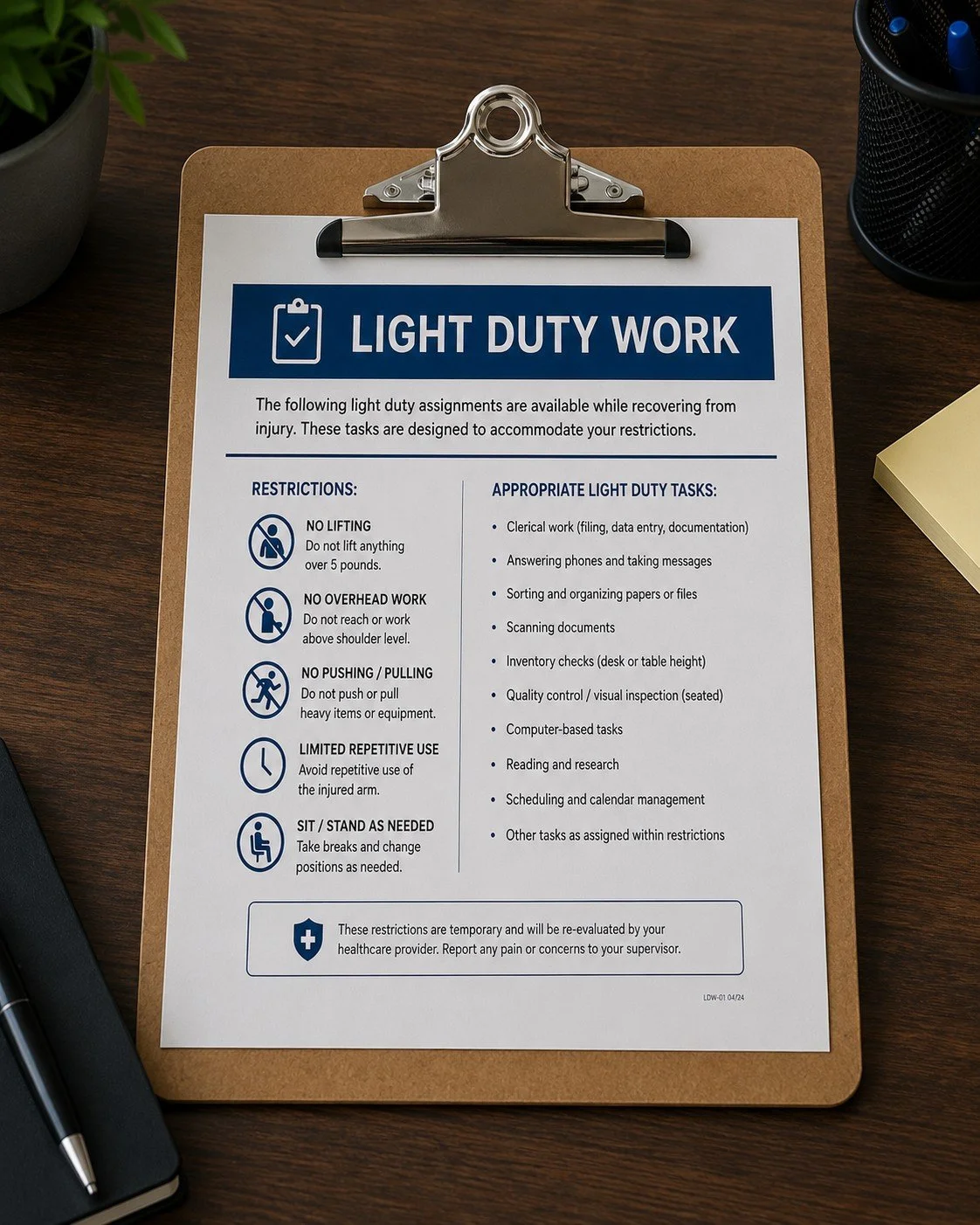
Conclusion
Losing your job does not necessarily mean you have lost your right to benefits.
As we have explored, the relationship between employment status and workers' compensation is complex. While your employer generally has the right to terminate employment in an "at-will" state like Minnesota, they cannot fire you because you sought workers' compensation benefits. Furthermore, even if you are terminated for reasons unrelated to your injury, you may still be entitled to wage loss benefits if your injury prevents you from finding new employment at your previous pay rate.
If you have been fired while on workers' comp, or if you suspect your termination was an act of retaliation for asserting your rights, do not assume your claim is over. These situations often require a detailed analysis of why you were let go and what restrictions you currently have.
Frequently Asked Questions
Can an employer fire you while you are on workers' comp in Minnesota?
Answer: Yes. Minnesota is an at-will employment state, meaning an employer can terminate an employee for any legal reason. However, employers are strictly prohibited from firing an employee in retaliation for filing a workers' compensation claim or asserting legal rights under the workers' compensation system.Does my employer have to hold my job open while I'm on workers' comp?
Answer: The Minnesota Workers’ Compensation Act does not require employers to keep an injured worker's specific position open. However, if the employer is covered by the federal Family and Medical Leave Act (FMLA), the employer may be required to protect the employee's job for up to 12 weeks.Do workers' compensation benefits stop if you get fired?
Answer: Generally, no. Termination of employment does not automatically end a workers' compensation claim. If an employee is terminated because the employer cannot accommodate physical work restrictions, the workers' compensation insurer must typically begin or continue paying wage-loss benefits.What happens if I am fired while working light duty?
Answer: If an employee is terminated while working under light-duty restrictions, that employee may be entitled to receive Temporary Total Disability (TTD) benefits to replace lost wages, provided the termination was not the result of severe, intentional misconductAbout the Author
Luke Smith is a Minnesota attorney that predominantly represents employees in workers’ compensation litigation. He graduated from Mitchell Hamline School of Law in 2016 and has been practicing workers’ compensation law since 2016. He has experience representing employers, insurance companies, and employees in workers’ compensation cases. A free consultation is available to Minnesota injured workers on request. Feel free to reach out with any questions about workers' compensation benefits.